Thank you to Redbridge Clinical Commissioning Group for providing the below
Oral questions from Cllr Andy Walker
Q: The CCG will be asked to seek an explanation from BHRUT as to why bed occupancy at Queens is 94% and 79% at KGH as CQC recommend a safe level of 85%.
A: In terms of high bed occupancy at Queen's, it's simple - too many people are being admitted to the hospital and those that are in there stay too long.
We launched two new services to Redbridge in November that are already having an impact on this - the Community Treatment Team and Intensive Rehab service - which help prevent admissions and also help get people home sooner. At the moment the CTT team at the hospital is able to treat and prevent around 60 people a week from being admitted. CTT teams in the community are currently treating and preventing more than 130 people a week from ending up in hospital. We've also reduced the time it takes to move people from a hospital to a community bed from 5 to 2 days.
The CCG and our health and social care partners are working in partnership to improve the integration of care so that people spend less time in hospital. The Trust is starting seven day working and a new joint discharge team will launch soon. Our draft 5 year strategic plan, which goes to NHSE in April, includes an objective to reduce avoidable time in hospital through integrating care by 13%.
The work we are doing on this with our health and social care partners has seen a reduction in admissions of 15% in the past 12 months and a reduction in A&E attendances of 5.67%.
Q: BHRUT is unable to provide waiting list figures for technical reasons and the CCG will be asked about this too.
A: This is caused by problems associated with the Trust's change of IT patient administration
system which means the Trust doesn't have access to accurate data and therefore isn't able to report waiting times at the moment.
This is a serious issue and the trust is working with the Trust Development Authority and our CCGs to help establish an interim solution while the IT issues are resolved.
Q: Cllr Walker will also call on the CCG to 'scrap the plan to close A&E at KGH in 2015'.
A: The plans to reconfigure services were signed off by the secretary of state for health in 2011, following a lengthy public consultation and an independent review by a panel of experts. Our job is to work with the hospitals Trust and other partners to implement those proposals safely and improve health outcomes for local people.
Centralising A&E services on one site will enable BHRUT to provide a safe, high quality A&E service. At the moment the service is stretched across two sites and the CQC identified that at times it may be unsafe because of this (e.g. staffing issues). We can't leave things as they are - it's not an option.
That's why we are looking at improving the entire urgent care pathway so that patients can be seen in the right place, more quickly, by the right teams with the right expertise and leading to better outcomes and shorter waiting times. Most people who go to KGH A&E now will still be seen there by an improved 24/7 Urgent Care Centre.
Last year we centralised maternity services and it has given us a safer, higher quality service for Redbridge women. That's what we plan for A&E.
Oral question from Cllr McGeary
Q: The improvements required by the Health for NEL proposals to A & E are likely to cost £50 million through the PFI route and are, as the trust says, unaffordable. How can the BHRUT say that they will still close King George A & E by December 2015 and still comply with the Secretary of State's statement that the reconfiguration changes will not happen until the health for NEL improvements have been made.
A: We've been very clear all along that changes to A&E services - just like maternity last year - cannot happen until it is safe to do so. That won't change. One result of the Trust being placed in special measures is that the new leadership is producing an Improvement Plan that will not only demonstrate how they will make the very necessary improvements to safety and quality of services, but will also show how they align this with the reconfiguration proposals.
----------------------------------------
Saturday, March 29, 2014

Thursday, March 27, 2014
Photo from today outside Redbridge Clinical Commissioning Group
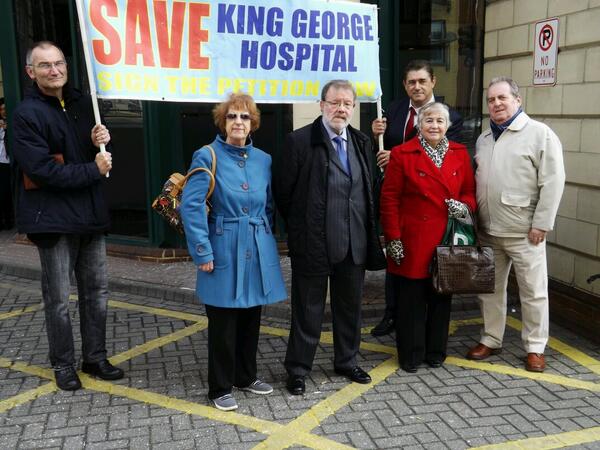
Thanks to Bob Archer for photo
Thanks to Councillors Fairley-Churchill and McGeary and Redbridge residents for attending.
The GPs made everyone welcome who wanted to speak, going out of their way to accommodate people by changing the agenda to let the public speak first to allow people to go after asking their questions rather than wait to the end of the meeting.
Valarie, a Redbridge resident made a passionate speech about how important King George Hospital is, her oratory drew a round of applause.
While no ground given by GPs on KGH A&E closure issue, GPs did appear to be concerned by the high bed occupancy rate at Queens hospital. This is an issue that needs to be kept under scrutiny as the CQC mentions a safe level of 85% and Queens was at 94% on March 16th.
GPs also appear concerned by BHRUT inability to provide waiting list figures. The responses to questions were detailed and I hope to be able to produce a note from the CCG of what was said in due course.
It is welcome that GPs are willing to have a dialogue with the public about the proposed closure of KGH A&E.
Wednesday, March 26, 2014
Photoshoot 12:30 Thursday 27th March Becketts House
There will be a photoshoot at 12:30pm outside Becketts House on Ilford Hill on Thursday 27 March before the Redbridge Clinical Commissioning Group meets.
The purpose is to call on the CCG to scrap the plan to close KGH A&E in 2015.
The CCG will be asked to seek an explanation from BHRUT as to why bed occupancy at Queens is 94% and 79% at KGH.
The CQC recommend a safe level of 85%.
BHRUT is unable to provide waiting list figures for technical reasons and the CCG will be asked about this too.
A Recorder photographer has been booked.
The purpose is to call on the CCG to scrap the plan to close KGH A&E in 2015.
The CCG will be asked to seek an explanation from BHRUT as to why bed occupancy at Queens is 94% and 79% at KGH.
The CQC recommend a safe level of 85%.
BHRUT is unable to provide waiting list figures for technical reasons and the CCG will be asked about this too.
A Recorder photographer has been booked.
Monday, March 3, 2014
As the Chair of BHRUT resigns, there are As the Chair of BHRUT resigns, there are strong parallels with Mid-Staffs as the public, experts and local politicians are ignored by NHS authorities
Neil Zammett writes
The news last Friday 21st
February that Sir Peter Dixon has resigned as Chair of BHRUT the trust that runs
Queen’s and King George is a body blow to local services and management
alike.
As a former Chair of the Housing
Corporation, University College Hospital and Enfield and Haringey Health
Authority Sir Peter is a highly regarded and experienced public servant whose
presence at BHRUT gave a calibre of leadership which it would be hard to
match.
He of course follows a similarly
distinguished Chair, Sir David Varney, who left the Trust after only six months
in June 2010, and joins the current medical director, finance director and chief
executive in departing.
Only very recently Sir Peter was
heard to say at a Scrutiny meeting that he was in it “for the long term” so
something significant has happened to prompt his
departure.
The answer to this lies in the
complex relationship between the Care Quality Commission (CQC), NHS England and
a shadowy body called the National Trust Development Agency (NTDA).
The CQC ‘s last report on BHRUT made
it clear that they had ran out of patience with the Trust’s inability to solve
the local crisis in A&E; a crisis that had lasted for three years, not just
days or months.
The NTDA, who effectively act for the
Department of Health, were faced with a recommendation from CQC to put the Trust
into “special measures”; they had to comply and this started the current
sequence of events.
Reading between the lines it is clear
that no one had worked out what “special measures” actually meant in this
case. It was so unclear that the NTDA despatched an NHS grandee,
Sir Ian Carruthers to the Trust to assess the situation after they had made the
announcement.
But before special
measures Sir Peter had already presented his assessment independently to
the NTDA backed up by management consultant’s report. Again we do
not know the detail but an important part of this assessment must have been a
need for resources and capacity.
We can imagine that the report would
have said something along the lines that: “Without the ability to source
adequate capacity to support both management and clinical staff, these hospitals
will continue to fail.”
Obviously Sir Peter’s arguments fell
on deaf ears.
The
Future
Whatever else this sad turn of events
has meant it is clear that the Health4NEL plan to close A&E at King George
has now run its course. There is no doubt that the management of
BHRUT have done their best but the colossal projected overspend for 2013-14, the
continuing dreadful performance of A&E and the departure of all the key
staff all point to the same conclusion-it is simply not
possible.
Even Professor Sir Mike Richards the
head of the CQC has gone on record about the huge challenge facing BHRUT which
he later described as “A task like Everest”.
The recently appointed turnaround
director and the interim finance director are both veterans of the South London
Trust and the administration regime while the new “interim” Chair Dr Maureen
Dalziel has only been given a three month contract. This would run
out at the end of May, around the time of the local
elections.
All of this suggests that Queen’s and
King George are being lined up for administration by the NTDA and local CCGs,
the GP organisations that now commission hospital services. The
timing of the new Chair’s contract suggests that a formal announcement will be
delayed until a politically less sensitive time.
Administration carries substantial
extra risks. There are already indications that the recruitment of
clinical staff is being adversely affected by the “special measures” and
managers are obviously not going to be rushing to join the Trust.
Morale at all levels must be at an all time low.
Administration would accelerate this process and could lead to
“recruitment blight” as has happened at Mid-Staffs.
More serious is the
fundamental difference of view between a very senior and experienced public
servant like Sir Peter and the NTDA. This cannot be dismissed as a
simple personality clash given the history outlined above and goes to the heart
of the continuing problems at BHRUT:
· On the one hand, the NTDA, the CCGs
and the Urgent Care Board (UCB) are still backing the Health4NEL
plan
· On the other Sir Peter, Redbridge
Council and this Blog see the need for more capacity and
resources.
Without a consensus on how to move
the Trust forward local people face a long period of uncertainty with failing
services and an emerging crisis of confidence and
leadership.
It’s just like
Mid-Staffs
When things go wrong in the NHS it is
difficult to find out who is responsible. At Mid-Staffs two
enquiries and two massive reports gave us some clues and some recommendations
about stopping this happening again. There are close parallels
between Mid-Staffs and BHRUT.
In both cases, a major problem was
the single minded pursuit of management objectives at the expense of patient
care. At Mid-Staffs it was foundation trust status; at BHRUT it is
the closure of A&E at King George.
At Mid-Staffs expert opinion from
Professor Brian Jarman was disregarded; at BHRUT it is Sir Peter’s and Sir
David’s from a management perspective and the evidence from this Blog from an
analytical one.
Finally there are the views of the
public and local politicians; again comprehensively ignored, just like Mid
-Staffs. I am not suggesting the consequences are on a comparable
scale but local people have had to endure a dreadful A&E service and
Redbridge women have been forced against their wishes to use a sub-standard
maternity service at Whipps Cross.
Who is
responsible?
Although the NHS reorganisation means
that many of the decision making bodies have gone, the NTDA as the controlling
successor body is primarily responsible.
But the CCGs and the Urgent Care
Board (UCB) although they are in a less controlling role still bear a heavy
responsibility for what is happening. Without their support the
NTDA could not continue with the closure plan. Surrey Downs CCG in South London
has done just that; pulling out of the equivalent plan to downgrade Epsom and St
Helier Hospitals.
Finally the CQC, while precipitating
the current management crisis, has very little authority to influence plans as
such, illustrating the weakness of accountability and regulation in market
economies.
What needs to
happen?
At the heart of this is the need to
scrap the Health4NEL plan. It clearly has not worked, there is
overwhelming evidence now that the assumptions underlying it were deeply flawed
and continued efforts to implement it have created the present crisis.
Making this decision is primarily the
responsibility of the NTDA. Redbridge CCG could take the lead on
this, however by following the example of Surrey Downs and withdrawing from the
plan. It’s up to them.
Local people need to be involved not
pushed to the margins. They are supposed to be at the centre of what the NHS
does, but locally their voice has been systematically ignored. The
same is true for local politicians. The CCGs and the UCB need to open up and
start listening to their views.
In particular there needs to be a
critical review of the schemes the UCB has funded this winter and their impact
on A&E performance. A central question is why the UCB has not
opened up more beds to ease the pressure on A&E. This is what
has precipitated the crisis.
Finally there is the issue of
ignoring expert advice. There is a sense in some quarters that the
NTDA and others are knowingly pushing BHRUT over the edge for whatever
reasons. This is a potential charge they should be given an
opportunity to answer in a way which makes them publicly accountable.
The news on Friday 21st
February that Sir Peter Dixon has resigned as Chair of BHRUT the trust that runs
Queen’s and King George is a body blow to local services and management
alike.
As a former Chair of the Housing
Corporation, University College Hospital and Enfield and Haringey Health
Authority Sir Peter is a highly regarded and experienced public servant whose
presence at BHRUT gave a calibre of leadership which it would be hard to
match.
He of course follows a similarly
distinguished Chair, Sir David Varney, who left the Trust after only six months
in June 2010, and joins the current medical director, finance director and chief
executive in departing.
Only very recently Sir Peter was
heard to say at a Scrutiny meeting that he was in it “for the long term” so
something significant has happened to prompt his
departure.
The answer to this lies in the
complex relationship between the Care Quality Commission (CQC), NHS England and
a shadowy body called the National Trust Development Agency (NTDA).
The CQC ‘s last report on BHRUT made
it clear that they had ran out of patience with the Trust’s inability to solve
the local crisis in A&E; a crisis that had lasted for three years, not just
days or months.
The NTDA, who effectively act for the
Department of Health, were faced with a recommendation from CQC to put the Trust
into “special measures”; they had to comply and this started the current
sequence of events.
Reading between the lines it is clear
that no one had worked out what “special measures” actually meant in this
case. It was so unclear that the NTDA despatched an NHS grandee,
Sir Ian Carruthers to the Trust to assess the situation after they had made the
announcement.
But before special
measures Sir Peter had already presented his assessment independently to
the NTDA backed up by management consultant’s report. Again we do
not know the detail but an important part of this assessment must have been a
need for resources and capacity.
We can imagine that the report would
have said something along the lines that: “Without the ability to source
adequate capacity to support both management and clinical staff, these hospitals
will continue to fail.”
Obviously Sir Peter’s arguments fell
on deaf ears.
The
Future
Whatever else this sad turn of events
has meant it is clear that the Health4NEL plan to close A&E at King George
has now run its course. There is no doubt that the management of
BHRUT have done their best but the colossal projected overspend for 2013-14, the
continuing dreadful performance of A&E and the departure of all the key
staff all point to the same conclusion-it is simply not
possible.
Even Professor Sir Mike Richards the
head of the CQC has gone on record about the huge challenge facing BHRUT which
he later described as “A task like Everest”.
The recently appointed turnaround
director and the interim finance director are both veterans of the South London
Trust and the administration regime while the new “interim” Chair Dr Maureen
Dalziel has only been given a three month contract. This would run
out at the end of May, around the time of the local
elections.
All of this suggests that Queen’s and
King George are being lined up for administration by the NTDA and local CCGs,
the GP organisations that now commission hospital services. The
timing of the new Chair’s contract suggests that a formal announcement will be
delayed until a politically less sensitive time.
Administration carries substantial
extra risks. There are already indications that the recruitment of
clinical staff is being adversely affected by the “special measures” and
managers are obviously not going to be rushing to join the Trust.
Morale at all levels must be at an all time low.
Administration would accelerate this process and could lead to
“recruitment blight” as has happened at Mid-Staffs.
More serious is the
fundamental difference of view between a very senior and experienced public
servant like Sir Peter and the NTDA. This cannot be dismissed as a
simple personality clash given the history outlined above and goes to the heart
of the continuing problems at BHRUT:
· On the one hand, the NTDA, the CCGs
and the Urgent Care Board (UCB) are still backing the Health4NEL
plan
· On the other Sir Peter, Redbridge
Council and this Blog see the need for more capacity and
resources.
Without a consensus on how to move
the Trust forward local people face a long period of uncertainty with failing
services and an emerging crisis of confidence and
leadership.
It’s just like
Mid-Staffs
When things go wrong in the NHS it is
difficult to find out who is responsible. At Mid-Staffs two
enquiries and two massive reports gave us some clues and some recommendations
about stopping this happening again. There are close parallels
between Mid-Staffs and BHRUT.
In both cases, a major problem was
the single minded pursuit of management objectives at the expense of patient
care. At Mid-Staffs it was foundation trust status; at BHRUT it is
the closure of A&E at King George.
At Mid-Staffs expert opinion from
Professor Brian Jarman was disregarded; at BHRUT it is Sir Peter’s and Sir
David’s from a management perspective and the evidence from this Blog from an
analytical one.
Finally there are the views of the
public and local politicians; again comprehensively ignored, just like Mid
-Staffs. I am not suggesting the consequences are on a comparable
scale but local people have had to endure a dreadful A&E service and
Redbridge women have been forced against their wishes to use a sub-standard
maternity service at Whipps Cross.
Who is
responsible?
Although the NHS reorganisation means
that many of the decision making bodies have gone, the NTDA as the controlling
successor body is primarily responsible.
But the CCGs and the Urgent Care
Board (UCB) although they are in a less controlling role still bear a heavy
responsibility for what is happening. Without their support the
NTDA could not continue with the closure plan. Surrey Downs CCG in South London
has done just that; pulling out of the equivalent plan to downgrade Epsom and St
Helier Hospitals.
Finally the CQC, while precipitating
the current management crisis, has very little authority to influence plans as
such, illustrating the weakness of accountability and regulation in market
economies.
What needs to
happen?
At the heart of this is the need to
scrap the Health4NEL plan. It clearly has not worked, there is
overwhelming evidence now that the assumptions underlying it were deeply flawed
and continued efforts to implement it have created the present crisis.
Making this decision is primarily the
responsibility of the NTDA. Redbridge CCG could take the lead on
this, however by following the example of Surrey Downs and withdrawing from the
plan. It’s up to them.
Local people need to be involved not
pushed to the margins. They are supposed to be at the centre of what the NHS
does, but locally their voice has been systematically ignored. The
same is true for local politicians. The CCGs and the UCB need to open up and
start listening to their views.
In particular there needs to be a
critical review of the schemes the UCB has funded this winter and their impact
on A&E performance. A central question is why the UCB has not
opened up more beds to ease the pressure on A&E. This is what
has precipitated the crisis.
Finally there is the issue of
ignoring expert advice. There is a sense in some quarters that the
NTDA and others are knowingly pushing BHRUT over the edge for whatever
reasons. This is a potential charge they should be given an
opportunity to answer in a way which makes them publicly accountable.
Friday, February 28, 2014
St Helier a lesson for Redbridge?
Thanks to Helen for pointing out developments in South London to me per the link below.
http://www.suttonguardian.co.uk/archive/2014/02/18/11018889.Improvements_to_Croydon_s_A_E_face_delays_after_multi_million_pound_review_scrapped/
The report says
"The preferred option for health bosses involved in the review was for St Helier and Epsom Hospital to lose their A&E and maternity departments and the equivalent departments at Croydon, St George's and Kingston to expand by 2017-18.
But the plans are now off the table, at least until new recommendations are published in June"
This suggests Redbridge CCG, working with other local CCGs could sink the plan to close King George Hospital A&E. Will Redbridge Council be lobbying the Redbridge Clinical Commissioning Group over this?
http://www.suttonguardian.co.uk/archive/2014/02/18/11018889.Improvements_to_Croydon_s_A_E_face_delays_after_multi_million_pound_review_scrapped/
The report says
"The preferred option for health bosses involved in the review was for St Helier and Epsom Hospital to lose their A&E and maternity departments and the equivalent departments at Croydon, St George's and Kingston to expand by 2017-18.
But the plans are now off the table, at least until new recommendations are published in June"
This suggests Redbridge CCG, working with other local CCGs could sink the plan to close King George Hospital A&E. Will Redbridge Council be lobbying the Redbridge Clinical Commissioning Group over this?
Tuesday, January 21, 2014
Re-visiting the Health4NEL Plan
Neil Zammett writes
This
month’s blog re-visits the review of the DMBC I wrote exactly three years ago.
Sadly it is all coming true and my forecasts of problems over
length of stay reductions, the balance between Inner and Outer London and the
impact of the Royal London rebuild are being fulfilled.
The
emerging truth is that the Health4NEL plan was deeply flawed and so heavily
biased towards Inner London in general and Tower Hamlets in particular that an
unstable situation has been created which can only be sustained by some form of
substantial external intervention of which finance is an important
part.
It
is not BHRUT that need to be put into “special measures” it is the National
Trust Development Agency for continuing to follow an outdated and badly through
plan. Without more resources local hospitals will continue to
fail, effectively subsidising surplus capacity in Inner London.
This is not just unfair it does not make long term service or financial
sense either.
The
review below is more of an essay than a blog but I would encourage readers to
stick with it and read it right through. It is very rare in my
experience for prophecies to come so comprehensively true.
Review
of the Health4NEL Decision Making Business Case
Background
I
have reviewed the Decision Making Business Case (DMBC); the 200+ page document
which was presented to the JCPCT as the basis for their decision to close
A&E and Maternity services at King George at their meeting on December
15th 2010. As always these are my personal views aimed at helping
elected members contribute to the decision making process.
For
those members who do not wish to read the whole document I have included a brief
conclusion below:
The
three main issues from the DMBC are; geographical equity between Inner and Outer
London, the impact of surplus beds in Inner London and the feasibility of
reducing bed numbers at Queen’s/King George in the time scale
proposed.
Further
work is required to give a definitive view but prima facie there are imbalances,
the issue of surplus beds after the BLT redevelopment has potentially very
serious implications which have not been addressed and no external view has been
taken on the proposed 250 bed reduction by 2013-14 at Queen’s.
Introduction
The
case for the closure is based in large part on the results of a mathematical
activity and capacity model. This uses very large data sets based
on health resource groups to predict the financial and patient flow effects of
closures.
Health
resource groups are small sets of hospital operations and procedure which have
costs and operational information such as length of stay associated with
them. There are several hundred of them and they are used
primarily to calculate income for the payment by results contracting system.
The
overview of the model and main results are shown in pages 75-96 of the DMBC and
a fuller version is given in pages 18-30 of the appendices. There
are also additional sections on the costing which I have not explored in any
depth. I do not propose to go into detail but feel it would be most helpful to
make some high level comments on the model.
I
would see its strengths as the ability to link income and activity together
accurately and therefore to predict the effects of closures. It
also separates out the effects of demand forecasts, efficiency improvements,
demand management and reconfiguration on caseload and bed numbers.
Finally it covers A&Es and outpatient attendances, and births,
planned and emergency admissions which make it comprehensive.
Results are presented as a series of tables and diagrams which show
changes in caseload and attendances for different time horizons (2013-14 and
2016-17) and also forecasts of bed capacity by hospital.
In
terms of weaknesses: the model does not treat day cases, those patients who
remain in hospital for less than a day, separately. This is a significant
omission because day case rates vary considerably and have a major impact on bed
usage. Unlike some earlier models it does not try to optimise some objective
function such as admission rates for each borough and therefore has no baseline
measure for equity.
There
is an additional point that is nothing to with the model itself and that is the
major PFI development at Barts and the Royal London which will be coming on
stream in 2012 has not been included in the future scenarios.
This
being said the model is in my view a very useful tool and the results have been
reported and illustrated particularly well, but need to be carefully interpreted
because of the weaknesses.
The
Results
Looking
at the results generally I was struck by the differences in capacity for
inpatient spells at the six hospitals. Barts and the London (BLT)
are clearly the largest at around 84,000 with Whipp’s and Queen’s not far behind
at around 70,000. Newham and King George are quite a bit smaller
at 44,000 with Homerton by far and away the smallest of the group with only
around 38,000 spells. King George is therefore in quite a big way of business
and by no means the smallest of the six.
Looking
at efficiency; there are no LOS tables provided in the DMBC so I did a quick
check by adding the non-elective and elective spells for 2010-2011 for each
hospital and the dividing by the number of beds. This gives a
throughput per bed, not the same as LOS but easier to calculate and a good
simple measure of efficiency. On this basis King George had a
figure of 112 spells per bed against Queen’s 94. In simple terms
this would mean that transferring the King George workload to Queen’s would
require 20% more beds because their overall efficiency is lower.
Although
these calculations are very crude they show the importance of looking critically
at existing performance as part of the context.
Obviously
summarising the results of such a large piece of work is difficult and I have
concentrated on the forecast bed capacity tables; 3.6.1-3.6.6 on pages 90-96 of
the DMBC because these are really central to the issues around closure.
One of the things that became clear to me straight away is that the
efficiency gains from LOS reductions varied enormously between hospitals even
allowing for their size,
It
appears that different assumptions for each hospital have been used which makes
the interpretation of some of the results quite complicated. The reason for this
appears to be that the ‘managers’ of each hospital have been allowed to select
their own assumption about gains in efficiency. Incidentally the
forecasts for expenditure have also been left to individual
hospitals.
The
Homerton, the smallest hospital has opted for no reduction while at Queen’s
/King George managers have selected a 22% reduction by 2013-14. Although the
report does say that comparison with bench mark figures indicates; ‘... that a
considerable reduction in length of stay should be achievable.’ it stops short
of endorsing this particular level or being more specific about the nature of
the comparison which was undertaken.
I
feel that this lack of consistency undermines the conclusions of the modelling
exercise in the sense that the results are based on different LOS inputs. The
model is not therefore predicting an outcome in terms of beds although it might
look as if it is; this is determined by the inputs. Equally allowing the Trusts
to input their own expenditure forecast without a consistency check raises
questions about the validity of the financial part of the model as
well.
I
would stress that these are not criticisms of the model per se or the way in
which the results have been presented but more the way in which inputs have been
allowed without consistency and equity.
The
Impact of the Barts and the London PFI
On
page 95 of the DMBC the author writes; ‘At Barts and the London the forecast
saving from reduced length of stay exceeds the amount needed for new demand
giving a net surplus of beds of 103 by 2014-14 (increasing to 113 by 2016-17).
However this is based on the current bad base; in 2011 the new buildings at the
Royal London and Barts open and this increases capacity thereby increasing the
potential surplus.’
The
Skanska website shows the bed numbers in the new build as 1248 an increase of
267 on the 2010-11 bed base in the DMBC. Reference to page 11 of the executive
summary of the Business Case for the new BLT shows a final figure of 1248 as
well but indicates that 250 beds will be ‘mothballed’.
Taking
the 1248 figure with the DMBC estimates would give a surplus of 370 by 2013-14.
My contact at Health4NEl does not have a comparable bed figure for
the new development which could include day case beds, so this figure needs to
be treated with caution.
When
one compares this with the estimates of 400 or so actual beds for Newham and 319
for Homerton it is evident that even allowing for some forecasting error there
are going to be some very difficult issues to face in Inner North East
London.
Discussion
This
admittedly superficial analysis raises a number of very serious questions about
the way in which plans for North East London (NEL) have been developed over the
past ten years or so. On the one hand in the three outer boroughs
bed and hospital numbers are going to be dramatically reduced while in the inner
three there is an existing bed surplus which will be increased by the mothballed
beds at BLT. These are not small bed numbers. The surplus at BLT
would equate to an average local hospital and the reduction at King George
manifestly is.
The
key issues here are;
Equity
between geographical areas
The
impact of the very large surplus bed at BLT
The
feasibility of reducing bed numbers at Queen’s/King George in the time
proposed
Equity
of provision
There
is a very real question about of provision between Inner and Outer London. In
very rough terms the surplus of beds in Inner London by 2013-14 equates to the
bed reductions in Outer London. If we take the three outermost
Boroughs there will be one hospital for 700,000 people and if we take the three
innermost, three for around 650,000.
Equally
there will be around 740 beds for the outer three and 1970 for the inner, nearly
three times as many. This assumes that all of the extra beds at
BLT would be opened. The status of the ‘250 ‘mothballed beds needs
urgent clarification therefore.
The
position of Whipp’s Cross ‘vis a vis’ the local Borough is an interesting
one. The hospital is large for the local population and always has
been and it represents a pivotal location for health services because it is well
placed to serve parts of Redbridge. In the DMBC analysis it is a
gainer or at worst not a loser.
Placing
Whipp’s in the Outer London Zone tends to give a false picture of relative
provision with Inner London because it is so large and therefore masks the
impact of the closure of King George on the three Outermost Boroughs.
In order to get a really fair picture more information is required on
inter borough patient flows to give catchment populations for each of the
hospitals. This is a really important piece of work.
However
the bed surplus at BLT clearly creates an imbalance starting off with a minimum
surplus figure of just over100 beds in 2010-11 and a bed complement of 981.
There will also be a much smaller future surplus at the Homerton.
This has not been estimated because they were allowed to opt-out of the
LOS reduction exercise
All
of this should in my view have been explored in more depth in the DMBC.
I cannot understand how the issue of equity could have escaped people’s
attention when it seems so obvious to me. Equally I cannot
understand why the issue of the surplus beds at BLT has not been
addressed.
In
fairness the author does specifically mention the point and gives the figures
but the potential impact on the proposals have simply not been dealt with.
As I have stated more information on patient flows is necessary to
make a proper judgement.
Impact
of the beds surplus in Inner London
With
such large potential numbers of surplus beds in Inner London I would have
expected the DMBC to be addressing the issue in some considerable detail.
Members of the JCPCT did not pick up on this point but given the quantity
of material they had to deal with this is not altogether surprising.
In
the current climate large bed surplus’ lead to financial and service
instability. I am not sure what the thinking behind mothballing the 250 beds at
BLT actually was, but even without them the logic behind closing beds in Outer
London while maintaining an existing large surplus in Inner London is hard to
fathom. This must put enormous financial strain on the system
quite apart from the issues of equity.
There
is an inescapable conclusion that had these facts been included in the original
decision making process the outcome could have been very different.
If the current proposal goes ahead there is also clearly an enormous risk
in financial terms to the stability of the health economy in North East
London.
Feasibility
of bed closures
Because
trusts were allowed to choose their levels of LOS reduction there was no
independent check on feasibility So at the Homerton no gains were
forecast which is a very unlikely outcome while at Queen’s/King George a
reduction of 22 % was forecast to 2013-14. The author acknowledges
that ‘The Trust and local stakeholders recognise the challenge that this
represents.’
What
is needed here is some check against LOS reductions in parallel situations to
see just how possible this scale of reduction is. There is obviously the danger
of making this a self fulfilling prophecy by simply closing the beds in question
with potentially serious effect on services and the public although this is
unlikely. Time scales are all important here as well. Trying to do
what is possible in ten years in five could have serious
consequences.
Again
in fairness the author of the DMBC sounds a warning note ‘Without this reduction
the closure of the King George A&E department cannot take
place.’
Conclusions
I
have placed my conclusions in the summary section at the beginning of the
document. I would simply add here the thought that one of the problems with
reviewing this type of document is the quantity of material involved which goes
well beyond the document itself and includes other large documents like the BLT
Business Case.
Finally
a caveat that although this represents my best efforts but, this is a highly
technical area crossing several disciplines and quite a bit of further work is
necessary by specialists to really bottom out the issues.
Saturday, January 18, 2014
How will Queens cope if KGH A&E Closes?
Bary Fleetwood writes
The A&E Question of Queens and King George
LARGEST A&E TRUSTS
Patients attending per year
Barts
Trust
4 A&E Units
290,000
Heart of
England Trust 2
A&E Units
240,000
Pennine
Acute Trust 4
A&E Units
240,000
Mid
Yorkshire Trust
3 A&E Units
210,000
Lewisham & Greenwich Trust 2 A&E Units 210,000
Leeds
Teaching Trust 2
A&E Units 200,000
BHRUT
2/1 A&E Units 199,000
After Reconfiguration, BHRUT will be the
largest one unit A&E in the country, there must be serious doubt that they
can design and operate an A&E this size with any success
WORST TRUSTS WITH
GREATER THAN 4HOUR WAIT
(for w/e 15/12/2013)
Hospital
Seen in less than 4hours
1.Mid Staffs 76.0%
2.Portsmouth Hosp. 78.1%
3.Kettering General Hospital 80.2%
4.Southampton Univ.Hosp 80.9%
5.King's College Hosp 82.4%
6.East Lancashire Hospitals 83.0%
7.Milton Keynes Hospital 83.8%
8.BHRUT 85.1%
9.Somerset and South Glos. 85.2%
10.Nottingham University Hosp 85.4%
The absolute refusal of ministers and the Trust to even
reconsider the Closure of King George A&E is simply a disenfranchisement of
the Voters of BHR Trust Hinterland, but not only these three boroughs but
abutting boroughs you have an arc from
Epping through to Grays that may use Queens, this makes close to a million
people served by Queens.
We do not yet know how big the reconfiguration for Queens
will be but, it will certainly not be enough, and the irony is that as the
population of this part of London explodes, and the rest of the population
ages, it is likely that by 2020 (with perfect sight) the Trust will almost
certainly have to open another A&E because Queens will be in the same
position as it is now, trying to push a gallon into a pint pot.Currently Queens
A&E is trying to cope with 130,000 patients p.a. when its capacity is only
90,000 is it any surprise it cannot cope.The 2010 Consultation imposed on BHRUT
was flawed then and now bears no resemblance to reality 4 years and population increases later, but blinkered Ministers
NHS England and NDTA cannot be seen to admit they are wrong.We also know that
Queens will be the largest single A&E unit in the country, and we also know
that the very largest A&Es are not as effective as medium sized A&Es.The Raison d’etre for
closing KG in the consultation was to consolidate services and make them
better, saving money we were told was not a consideration, except we now know
that this was simply an outright lie, or outright stupidity by the authors.
Let us examine the Reconfiguration, most of which is now
public knowledge for King George, which will go from a modern Acute General
District Hospital to the largest Polyclinic in the world, with no A&E, not
what it was built for.The Trust has not been in the least bit honest,it has
laid out what bits of the hospital will be for what purpose, and said “Those
parts not used we will find uses for” which we all know is Trustspeak for
selling off as much as possible.
Although the Trust does not publish the A&E split
between KG and Queens (however this will shortly be remedied.)from the little
information that is available, it would appear that KG is close to the 95% 4
hour waiting time target ,whilst with an average last week of 84.1% the worse
than we think performance of Queens is hidden, it is probably somewhere near
76-79%.Nor will they publish the split of patients between KG and Queens the
only figures are from a very obscure
document “Quality Account” 2012-13 (this omission will also shortly be
remedied)

These figures are a year old so they have probably
increased, this does not agree with the other figure for Queens which is
bandied about and in several documents of 130,000 a year, there are anomalies
in the figures above as the daily figures do not correspond with the yearly
figures, The statistics reported to NHS England every week appear to support
about 200,000 patients a year in A&E for both KG and Queens, so what is
true, this produces a number of
questions
What figures can we believe?
Does the Trust actually know what the figures are?
.
Although the KG reconfiguration has been published,
absolutely nothing has been published for Queens
These questions remain unanswered
The current alleged capacity of Queens is 90,000 p.a. NO
Capacity has been promulgated for the Reconfiguration.
The cost of the Reconfiguration, appears to be unknown to
both the Public and The Trust itself,The Trust this Financial Year will have a
deficit of between £27 -£33 million, to add to the already existing £100M +
deficit, just how does the Trust propose financing the Reconfiguration?, The
reconfiguration is not going to be cheap, is likely to be many millions rather
than a few ,
Ministers , Trust Executives and CCG executives have all
used the phrase “KG A&E will not be closed until it is “Clinically safe to
do so”, The Minister has refused to name the criteria to be used, the Havering
MPAndrew Rosindell has ignored a request to ask the minister to name the
criteria and quantitive figures to measure “Clinically Safe”, NO-ONE seems to
know what this phrase means, one has to believe that CLAIRVOYANCY is the going to be the method of determining
“Clinically Safe”.
Now let us examine how big the reconfigured A&E should
be, currently we have for Queens any where from 130,000 to to 147,000 and for
KG anywhere between 73,000 and 100,000, (of course what this does point up is
that the Trust is simply not consistent with its figures-the Trust believes –
with no supporting evidence (and I believe it is simply a guestimate) that 30%
of KG A&E patients will transfer to Queens A&E when KG is closed. In my
opinion this is a fallacious argument probably a much higher percentage will transfer , when people want an A&E
they want an A&E not a pale imitation as is planned for KG So at the very
minimum according to the Trust (and we have already demonstrated their figures
are hugely suspect)there will be between 155,000 and 177,000 with a possible high figure of between 230,000 and 257,000, to add to this the NHS
recognises and has published that for a
new A&E for the first 6 months there is a 15-20% increase over and above
the normal number of patients.This takes no account of any increase in population
which will increase the call for A&E facilities especially for children. The
other point is that no mention has been made of
future use, even though the Trust is legally bound to publish a 5/10/20
year plan and forecast for a new A&E
We already know that very large A&Es’ perform
significantly worse than the smaller ones, which is frightening for Queens for
it to reduce its performance from an already dangerously low point.The people
of the three boroughs expect and deserve something infinitely better. The
original Consultation said that the reconfiguration would deliver a much safer,
better performing and more efficient A&E
if as is likely that the Unit might have to deal with nearly a quarter
of million patients a year does anyone actually believe that? And we have not
even considered the huge number of Consultants, middle range and junior doctors
that will be needed, along with nurses and support staff, none of which vacant
positions the Trust seems able to fill. We have yet to see the alleged 30+doctors
from India actually in place and REMAIN in place once here. One also has to
wonder about both their suitability ,experience and temperament to operate in
the high pressure of A&E.
Having said all this about Queens, the A&E itself is in
an impossible position, trying to put 130,000 a year into a 90,000 a year pot. Every
part of the system is responsible for the failure of Queens, CCGs Councils and
not helped by the failure of Scrutiny Committees and the CQC which gives
local GP practises with 18 day waits for
an appointment a clean bill of health, they have no incentive to improve, not
least the Councils themselves, where home care either is not in place or fails,
which means that the elderly infirm and disabled get taken to A&E instead
of being dealt with by carers and GPs.
The pressure on A&E can only be resolved by ensuring
that the other parts of the system work effectively, GPs with reasonable
waiting times, CCGs ensuring this is so, councils spend enough on home care,
and Scrutiny Committees making sure they all do their job correctly, otherwise
what you end up with is that A&E does the GPs job for them, and under those
circumstances every single A&E in the country will fail. We know that GPs
and CCGs are failing to relieve the pressure on A&Es there is no reason to
believe that the third part the Councils with home care, with budgets under
huge pressure are any different and failing despite Council spin to the
contrary.
Scrutiny Committees have so far have shown very
little evidence that they also have a grip on the situation or have any
effective influence on any of the participating partners.
It is a truism that all Outer London Hospitals have
suffered from decades of under investment and under funding, the money has all
gone to the “Glamorous” Teaching hospitals in Inner London, making them some of
the best in the world, but depriving the rest of London of desperately needed
funding-just look at how much equipment has been provided by groups of “Friends
of the Hospital”. The problem is not nearly as bad in the rest of the country,
where funds are spread much more evenly, rather than concentrated on Teaching
Hospitals, drawing money away from the very hospitals that treat the 1000s
everyday in Outer London. The
Government and NHS England urgently need to review the funding for all Outer
London Hospitals.
The cost of Reconfiguration has not been published
as yet however this is not going to be a cheap operation it will not be £2/3
million, We do know that the Chase Farm/Barnet Reconfiguration cost – hold onto
your seat- £114 million, so how much money was saved there? So our
reconfiguration is quite probably going
to be in the tens of millions, and one has to ask the question is it actually
going to save any money in the foreseeable future, would this money not be better
spent retaining both A&Es? The Trust is frankly bust, with an accumulated
deficit of over £100 million and forecast deficit of between £27 -£33 this year,
so the money has to come from somewhere else, hopefully not from the PFI
Partner, as the PFI agreement is partly responsible for the Trusts cash
problems, this really only leaves the NTDA (The NHS
Trust Development Authority)
In this climate is the NTDA
actually going to be able to rustle up this level of money? Bearing in mind
there may even be a change of Government in between. In all honesty, what makes
more sense is to invest this money in both A&Es, as has already been said
by 2020 it is quite possible that we will need another A&E anyway.
We have to praise the Staff of KG
and Queens A&E for doing an almost impossible job, with great skill and fortitude,
under an almost impossible pressure, this is due to enormous under funding, a
failure of other parts of the system and the stupidity of trying to enforce a
flawed and unwanted 4 year old consultation, with Senior management stuck
between a rock and a hard place.
Subscribe to:
Posts (Atom)